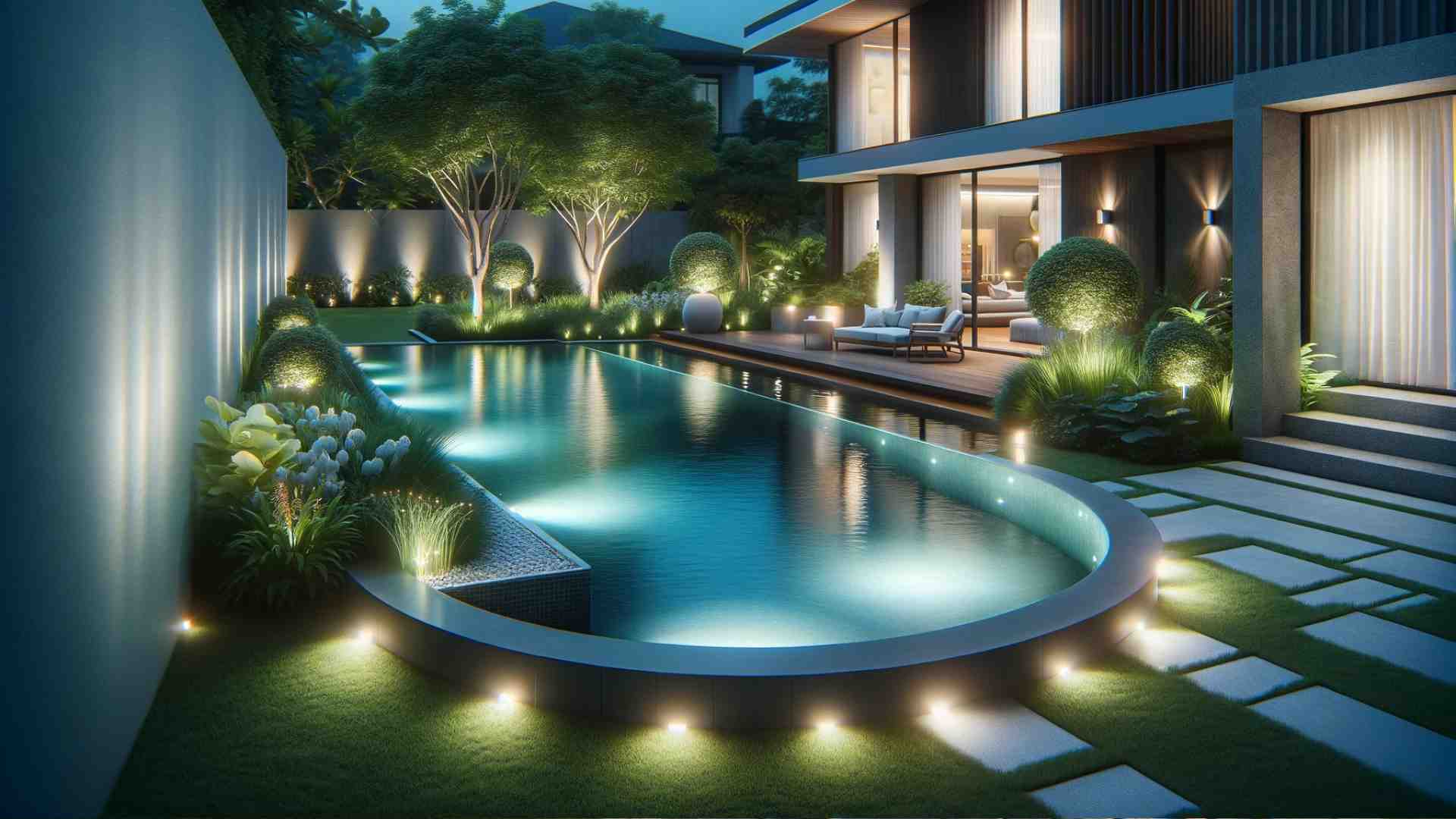
Whether you’re an expert in pool care or a newcomer just looking to enhance your backyard oasis, our guide will walk you through the world of pool lighting with ease. So let’s dive right in and explore how outdoor lights can transform your swimming experience, creating the perfect ambiance for fun-filled nights, serene relaxation, or simply a well-lit swim.
Remember, we’re not just talking about your average pool lighting here; we’re delving into the realm of outdoor lighting in general. From backyard lighting that adds character to your pool area to the dazzling world of underwater LED lights, we’ve got you covered. So grab your favorite pool float, and let’s embark on this illuminating adventure together!

5 types of pool lights
Let’s talk about five of the most common pool light types that can transform your swimming experience and elevate your backyard’s ambiance. With options such as energy-saving LED lights, mesmerizing fiber optic lights, playful floating lights, and dedicated above ground and inground pool lights, there’s a lighting solution for every pool owner.
In this easy-to-understand guide, we’ll explore each type of pool light, highlighting their unique features, benefits, and applications. Dive in with us and discover the ideal pool lights to brighten up your backyard and enhance your swimming experience.
1. Illuminate Your Pool Area: A Closer Look at Above Ground LED Pool Lights

Above ground pool lights, specifically LED ones, are designed to illuminate your pool area from outside the water, providing visibility and ambiance without being submerged.
These lights are installed around the perimeter of the pool, either on the pool walls, deck, or nearby structures like a gazebo or fence. They are positioned above the waterline, which means they are not in direct contact with the water. here are some of the thing you’ll have to know:
Outline Points:
- Definition of above ground pool lights (LED)
- Placement of these light fixtures
- Working voltage for these lighting fixtures
- Installation process
- Special infrastructure requirements
- Recommended height for installation
- Choosing between wide or narrow beam lights
Q: What are above ground pool lights?
A:
Above ground pool lights are usually installed around the perimeter of the pool, either on the pool walls, deck, or nearby structures like a gazebo or fence.
Above ground pool lights, specifically LED ones, are designed to illuminate your pool area from outside the water, providing visibility and ambiance without being submerged. These lights are installed around the perimeter of the pool, either on the pool walls, deck, or nearby structures like a gazebo or fence. They are positioned above the waterline, which means they are not in direct contact with the water.
Q: What about the working voltage for these lights?
A:
When it comes to the working voltage of these lighting fixtures, above ground pool lights typically use low voltage, around 12 volts. This makes them energy-efficient and safe for use near water.
Q:how do I install these lights?
A:
The installation process can be relatively simple, depending on the type of lights you choose. Some lights can be mounted directly onto the pool wall or deck, while others may require brackets or posts. It’s essential to follow the manufacturer’s instructions, and we recommend consulting a professional electrician to ensure proper installation and safety.
Q: Is there any special infrastructure needed for these lights?
A:
In most cases, no special infrastructure is required for above ground pool lights. However, you will need to ensure that there’s a proper electrical source nearby and that any necessary wiring is safely and securely installed. Some lights may require a transformer to convert the voltage. In our opinion, this lighting should not be installed without a qualified electrician
Q:What’s the recommended height for installing these lighting fixtures?
A: As for the recommended height for installing these lighting fixtures, it can vary depending on your specific pool layout and desired lighting effect. Generally, we suggest installing the lights between 18 to 24 inches above the waterline. This height provides optimal illumination without causing excessive glare.
Q:Should I choose lights with a wide or narrow beam? Are there specific situations where one is better than the other?
A:
The choice between wide and narrow beam lights depends on your desired lighting effect and pool area layout. Wide beam lights are great for general illumination, providing even coverage across a larger area. Narrow beam lights, on the other hand, create focused and intense lighting, which is perfect for highlighting specific features like waterfalls or sculptures. Ultimately, you can mix and match the beam types to create your ideal pool lighting setup.
By addressing these points, we hope to provide a comprehensive understanding of above ground pool lights, their placement, voltage, installation process, infrastructure requirements, recommended installation height, and the differences between wide and narrow beam lights.
2. Led pool lights

First, let’s discuss what a LED is and why it’s great for pool lighting. LED stands for Light Emitting Diode, which is a semiconductor device that emits light when an electric current passes through it. LEDs have several advantages when it comes to pool lighting:
Energy efficiency: LEDs consume significantly less energy compared to traditional incandescent or halogen bulbs, helping you save on electricity costs.
Longevity: LEDs have a longer lifespan, often lasting up to 50,000 hours or more, which means fewer replacements and lower maintenance costs.
Safety: LEDs produce minimal heat and operate at a lower voltage, making them safer for use around water.
Versatility: LEDs are available in various colors and brightness levels, allowing you to create the perfect ambiance for your pool area.
For pool lights you also have to check the IP rating
Waterproof IP (Ingress Protection) rating is a standardized classification system that measures the level of protection a product has against the intrusion of solid particles (such as dust) and liquid (such as water). This rating is essential for LED pool lights, as they need to be resistant to water and humidity to ensure safety and durability in wet environments.
The IP rating consists of two digits. The first digit represents the protection against solid particles, such as dust, and ranges from 0 (no protection) to 6 (complete protection against dust).
The second digit indicates the protection against water intrusion and ranges from 0 (no protection) to 9 (protection against high-pressure, high-temperature water jets). The higher the number, the greater the level of protection.
For LED pool lights, a high IP rating is crucial since they are exposed to water and humidity. At a minimum, LED pool lights should have an IP rating of IPX5, which offers protection against water jets from any direction.
However, for lights that will be submerged in the pool, an IP rating of IPX7 (protection against immersion in water up to 1 meter for 30 minutes) or IPX8 (protection against continuous submersion in water beyond 1 meter) is necessary to ensure safe and reliable performance.
In summary, understanding the IP rating system is essential when selecting LED pool lights, as it determines their suitability for use in wet environments. Always choose LED pool lights with a high IP rating to ensure safety, durability, and reliable performance in and around your pool.
LED lights for your pool
Now, let’s talk about how to use LED lights for your pool. It’s a good idea to start with outdoor lighting surrounding the pool area, such as pathways, decks, and landscaping.
This will help set the mood and provide general illumination for safety and visibility. Next, focus on the pool itself, using LED lights to highlight features like steps, waterfalls, or fountains, as well as to provide even illumination throughout the water.
The degree of opacity for LED pool lights refers to how much light the fixture allows to pass through. In other words, it determines how diffuse or focused the light will be. Opacity is usually measured in degrees, with a lower degree indicating a more focused, narrow beam of light, and a higher degree indicating a more diffuse, wide beam of light.
The ideal degree of opacity for your LED pool lights depends on the desired lighting effect and the size of your pool.
For general illumination and even coverage, you might want to consider LED lights with a higher degree of opacity, such as 120 or 140 degrees. This will produce a soft, wide beam of light that covers a larger area.
On the other hand, if you want to accentuate specific features in your pool or create dramatic shadows and highlights, you may prefer LED lights with a lower degree of opacity, such as 30 or 45 degrees, which produce a more focused, narrow beam of light.
By understanding these factors, you can choose the perfect LED pool lights to create the desired ambiance and enhance your swimming experience.
3. Fiber Optic Pool Lights Safe, Stunning, and Versatile Lighting Solutions

Fiber optic pool lights are a unique type of pool lighting that uses optical fibers to transmit light from a single light source to various locations in and around the pool. The light source, typically an LED or halogen bulb, is housed in a separate, dry location known as the illuminator or light box.
The optical fibers carry the light from the illuminator to the various light fixtures or end fittings in the pool, creating a captivating and visually stunning effect.
The main use for fiber optic pool lights is to create stunning visual effects and ambiance in and around the pool area.
They are particularly popular for accent lighting, as they can be used to highlight water features, steps, edges, or other pool elements. Additionally, fiber optic lights can be used to create mesmerizing color-changing displays, as the color of the light can be easily adjusted at the illuminator.
One of the significant advantages of fiber optic pool lights is their inherent safety. Since the optical fibers themselves do not carry electricity, only light, there is no risk of electrical hazards in the water.
As a result, the fiber optic lights and end fittings used in the pool are considered waterproof. However, it is essential to ensure that the illuminator is installed in a dry, protected location, as it contains electrical components.
Fiber optic pool lights typically operate at a low voltage, usually around 12 volts. This low voltage contributes to their safety and energy efficiency. The illuminator will often include a transformer to convert the standard household voltage (110-240 volts) to the required low voltage for the system.
In summary, fiber optic pool lights are a unique and visually captivating lighting option that offers safety and versatility for creating stunning effects and ambiance in and around your pool. With their waterproof end fittings, low voltage operation, and ability to highlight various pool features, they can be an excellent choice for accent and mood lighting in your pool area.
4. Light Up the Night with Floating Pool Lights: Fun, Versatile, and Effortless Illumination

Picture this: you’re relaxing by your pool, and the sun starts to set, casting a warm glow over your backyard. As the evening unfolds, your pool transforms into a magical oasis, thanks to floating pool lights.
These whimsical, portable lights rest on the water’s surface, adding an enchanting touch to your pool area. With a variety of shapes, sizes, and designs to choose from, floating pool lights bring an unmatched sense of personality and charm to your backyard retreat.
Powered by energy-efficient LED bulbs or solar energy, floating pool lights are both eco-friendly and easy to operate. Battery-operated LED lights offer convenience, while solar-powered lights feature built-in solar panels that charge during the day and automatically light up at night.
Some models even boast color-changing features, controlled by a remote or smartphone app, allowing you to customize your pool’s atmosphere to your heart’s content.
The main purpose of floating pool lights is to create a captivating, soothing ambiance for those unforgettable pool parties, late-night swims, or serene evenings by the water. Their soft glow provides a subtle illumination, enhancing your nighttime swimming experience.
When it comes to placing these delightful lights, simply set them on the water’s surface and let them drift. Feel free to scatter them randomly or arrange them in creative patterns to create your perfect ambiance. And for those who prefer a more stationary setup, some floating pool lights come with anchors or suction cups.
In terms of design, the classic orb or globe shape is the most common form, casting a gentle, even glow in all directions. But if you’re looking for something more unique, there’s a wide array of creative designs available, from flowers and animals to novelty shapes. The choice is yours, so let your personality shine!
In a nutshell, floating pool lights offer an enchanting, versatile way to elevate your pool’s ambiance and make your nighttime swims even more enjoyable. With their alluring designs, simple setup, and low maintenance, these charming lights are the perfect addition to any backyard pool area.
5. Inground Pool Lights (LED): A Comprehensive Guide to Elevate Your Swimming Experience

Understanding Inground Pool Lights and Their Applications
Inground pool lights are lighting fixtures specifically designed to be installed within the pool walls or floor. They serve multiple purposes, including enhancing the aesthetics of your pool, creating a magical and inviting atmosphere, and improving visibility and safety during nighttime swims. One popular option is LED inground pool lights, which operate at a low voltage, typically around 12 volts. This low voltage makes them energy-efficient and safe to use in a wet environment.
Determining the Right Number of Lights and Installation Process
Given the importance of pool lighting, it’s crucial to determine the appropriate number of lights for your pool. For a 10×12-foot pool, the number of inground lights required will vary depending on factors such as the pool shape, depth, and desired illumination level.
Generally, it’s recommended to have one light for every 100-200 square feet of pool surface area. In this case, 2-3 lights should suffice. However, consulting with a pool lighting professional is always a good idea to determine the optimal configuration for your specific pool. Once you have a plan in place, it’s time to consider the installation process.
The installation process for inground pool lights involves several steps. First, plan the layout, including the placement of the lights, junction boxes, and wiring. It’s highly recommended to work with a licensed electrician or pool contractor, as they will ensure proper installation and compliance with local regulations.
Inground pool lights are typically installed 9-12 inches below the waterline. This strategic placement ensures the lights remain submerged and properly illuminate the pool, enhancing both aesthetics and safety. With the lights installed, you may want to consider different beam options for the best results.
Choosing the Right Beam: Wide vs. Narrow
Inground pool lights come with different beam options: wide and narrow. Wide beams provide more uniform and diffused lighting, making them ideal for general illumination and enhancing the overall ambiance of your pool area.
Narrow beams, on the other hand, create more focused and intense lighting, suitable for highlighting specific features, such as waterfalls or pool steps. The choice between wide or narrow beams depends on your personal preferences and intended use.
To sum it up, if you want to create a more relaxing and inviting atmosphere, wide beams may be the better option. However, if you have specific features you’d like to showcase, narrow beams could be the way to go.
Ultimately, LED inground pool lights offer a stylish, energy-efficient, and safe way to illuminate your pool area, and with the right planning, professional assistance, and attention to detail, you can achieve the perfect balance of form and function, transforming your pool into a true backyard oasis.
Pool Lights 101 FAQ: Understanding Costs, Lifespan, and Syncing

Welcome to our quick guide on pool lighting! We’re here to help you navigate the essential aspects of illuminating your pool, covering topics such as the number of lights needed, costs, lifespans, and syncing your lighting system.
With this handy information at your fingertips, you’ll be ready to create a beautiful and functional pool lighting setup in no time.
How many lights are needed for a pool?
The number of lights needed for a pool depends on the pool’s size, shape, depth, and desired illumination level.
As a general rule, it’s recommended to have one light for every 100-200 square feet of pool surface area. Additionally, it’s important to consider the pool’s configuration and features to ensure proper illumination.
Consulting with a pool lighting professional can help you determine the optimal number of lights for your specific pool, taking into account both functional and aesthetic aspects.
How long do pool lights last?
Pool light lifespans vary, with LED pool lights lasting significantly longer than traditional incandescent or halogen bulbs.
Traditional incandescent and halogen bulbs typically last between 1,000 and 5,000 hours. LED pool lights, on the other hand, have a much longer lifespan, ranging from 30,000 to 50,000 hours or more.
This extended life makes LED lights a more cost-effective and environmentally friendly option compared to traditional bulbs. It’s important to note that the actual lifespan of a pool light may be influenced by factors such as usage patterns, water chemistry, and maintenance practices.
How much do LED pool lights cost?
LED pool light costs vary depending on the brand, quality, and features, with an average range of $50 to $300 per bulb.
The cost of LED pool lights varies depending on factors such as the brand, quality, features, and installation requirements. On average, an LED pool light bulb can cost anywhere from $50 to $300, with higher-end models offering additional features such as remote control, color-changing capabilities, and energy-saving functions.
It’s essential to consider not only the initial cost of the lights but also the long-term operational costs, as LED lights are more energy-efficient and have a longer lifespan than traditional bulbs. Keep in mind that installation costs can also vary, depending on the complexity of the project and whether you choose to work with a professional installer.
How to sync pool lights?
Syncing pool lights involves following the manufacturer’s instructions, which may include power cycling or using a remote control.
Synchronizing pool lights, particularly color-changing LED lights, can create a cohesive and visually stunning effect in your pool area. The process for syncing pool lights depends on the specific system and model you’re using. Most modern LED pool lights come with a built-in synchronization feature or remote control that allows you to easily sync multiple lights.
Here’s a general process for syncing pool lights:
- Turn off the power to the pool lights at the main switch or breaker.
- Wait for a few seconds (usually 5-10 seconds) to allow the lights to reset.
- Turn the power back on.
- Depending on the specific system, the lights may automatically sync upon power-up, or you may need to use a remote control or follow a sequence of power-cycling (turning the power off and on) to enter the sync mode.
Always refer to the manufacturer’s instructions for the precise synchronization process for your specific pool light system. If you encounter difficulties or are unsure of the process, consult a pool lighting professional for assistance.
Shining a Light on Pool Illumination: Our Fun and Informative Conclusion

As we wrap up our enlightening adventure through the world of pool lighting, we hope you’ve found our insights both illuminating and entertaining. After all, who knew that lighting up your pool could be such a bright idea? From LED and fiber optic lights to floating and inground options, there’s a whole spectrum of choices to make your pool shimmers like a disco ball or twinkle like a starry night sky.
But wait, there’s more! Why stop at pool lighting when you can keep the party going with garland lights? Be sure to check out our article on “5 Fantastic Ideas for Garland Lights Uses” to discover even more ways to dazzle your friends and family. Trust us, you won’t want to miss these radiant tips and tricks that will transform your backyard into a magical wonderland. So, go on and dive into the world of lighting – after all, life’s too short to swim in the dark!